Node
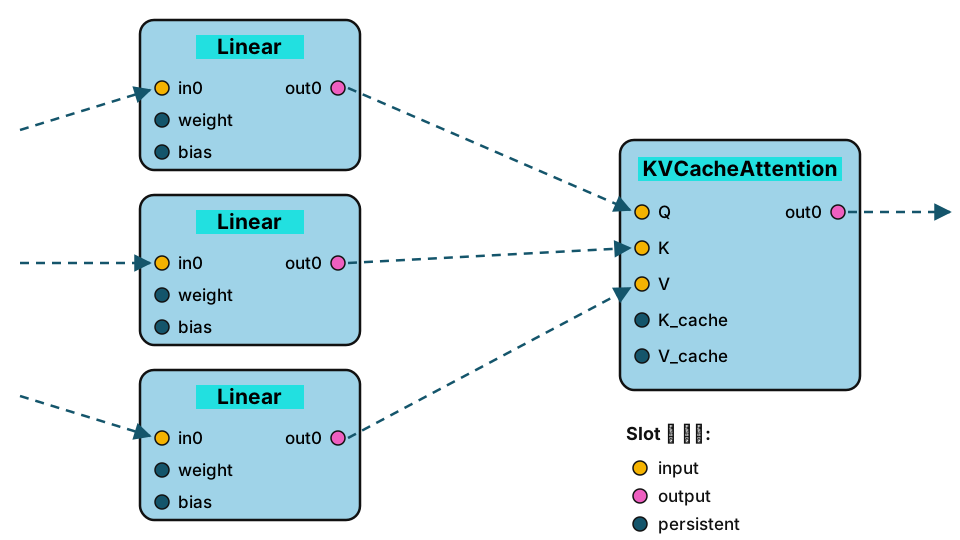
A Node represents one operation. It receives Tensor values through named slots, performs an operation, and passes the results out through slots. A node can record multiple GPU kernels; nodes such as Identity and Flatten share buffers without recording compute commands.
vai::node::Linear linear({.inDim = inDim, .outDim = outDim});
vai::node::Attention attn({
    .headDim = 64,
    .numQHeads = 8,
    .numKVHeads = 2,   // GQA: defaults to numQHeads if omitted
    .kvCacheSize = 1024,
});
Each node defines its slots in its constructor. The two node types in the diagram define them as follows:
Linear::Linear(Config config)
: config_(config)
{
    addSlot("out0", NodeSlot::output);
    addSlot("in0", NodeSlot::input);
    addSlot("weight", NodeSlot::persistent);
    addSlot("partial", NodeSlot::temporary);   // Allocated only when using the reduce pass
    addSlot("bias", NodeSlot::persistent);
    if (config_.acceptResidual) addSlot("residual", NodeSlot::input);
}
Attention::Attention(Config config)
: config_(config)
{
    addSlot("out0", NodeSlot::output);
    addSlot("Q", NodeSlot::input);
    addSlot("K", NodeSlot::input);
    addSlot("V", NodeSlot::input);
    addSlot("partialO", NodeSlot::temporary);    // Split-K partial sums, allocated only when kCount > 1
    addSlot("partialML", NodeSlot::temporary);

    // ... Compute Hkv
    if (config_.kvCacheSize > 0)
    {
        addSlot("K_cache", NodeSlot::persistent);
        addSlot("V_cache", NodeSlot::persistent);
        // ... Create cache tensors
    }
}
The slot configuration can depend on the options. Linear has residual only when acceptResidual is set. Its bias slot always exists and applies only when the weights fill it. Attention's cache slots exist only when kvCacheSize > 0. The partial slot, omitted from the diagram, is an internal buffer for the operation. It is not used for graph input or output connections.
1. Slots
Slots are ports through which Tensor values pass. There are four types, each with a different source of values.
| Type | Source of the value (tensor) | Value lifetime |
|---|---|---|
input |
Output of a preceding node or external input | Updated on each execution |
output |
The node itself (created in prepare() and filled by run()) |
Updated on each execution |
persistent |
The user (weights) or the node (caches and constant tables) | Retained across network executions |
temporary |
The node itself | Valid only during run() |
1.1 input
Receives the output of a preceding node connected with -. At the start of the graph, NeuralNet connects it to an external input.
1.2 output
In prepare(), the node chooses the dtype, computes the result shape, and creates a tensor. run() records GPU commands to fill that buffer, which holds the result when execution finishes.
1.3 persistent
These slots retain values between executions. There are two cases.
1. The user prepares weights: These slots hold learned parameter values, such as Linear's weight and bias. If they are not prepared, shape validation in Node::prepare() fails.
vai::Checkpoint ckpt(VAI_DATA_DIR "/ckpts/mnist/jroot");
const vai::Dtype wDt = net.config().wDefaultDtype;   // the net's weight dtype
linear["weight"] = vai::Tensor(ckpt["fc.weight"], wDt);
linear["bias"]   = vai::Tensor(ckpt["fc.bias"], wDt);
2. The node prepares other values itself: Examples include Attention's K_cache and V_cache, and Rope's freqs.
// Attention constructor: the node creates the cache itself.
(*this)["K_cache"] = Tensor({Hkv, config_.kvCacheSize, config_.headDim}, config_.kvCacheDtype);
Whether the value is fixed, as with weights, or accumulates at each step, as with a KV cache, persistent buffers remain alive between executions. input and output buffers are updated on each execution and reused through the buffer pool.
1.4 temporary
These are workspace buffers used only inside an operation. They may be needed only on a particular execution path, as with Linear's partial; no buffer is allocated when that path is not used.
2. Working with slots
2.1 Slot names
Slots are declared in the constructor with Node::addSlot. Users cannot add new names from outside the node, and accessing a nonexistent name throws an exception.
The per-node slot tables in Built-in nodes list the available slots.
2.2 Reading values and accessing slots
Node::operator[] and Node::slot() have similar names but return different objects.
linear["weight"];       // Tensor&    Read and store the value
linear.slot("out0");    // NodeSlot&  Used for connections
The - operator calls slot() internally. Use [] for values and slot() for graph connections.
3. Connections
The - operator connects an output slot of the node on the left to an input slot of the node on the right. Use / with a name to choose the slot.
3.1 Selecting slots
The / slot selection operator chooses an input slot on the left side of a node and an output slot on its right. This follows the left-to-right direction of data flow.
When / is omitted, the slot before the node defaults to in0, and the slot after the node defaults to out0.
| Notation | input slot |
output slot |
|---|---|---|
node |
in0 |
out0 |
"X"/node |
X |
out0 |
node/"Y" |
in0 |
Y |
"X"/node/"Y" |
X |
Y |
The connection above can therefore be shortened to:
Only input slots can appear with / before a node, and only output slots can appear after it. persistent and temporary slots are not used for graph connections.
3.2 Nodes with multiple slots
Nodes with multiple inputs need explicit slot selection. For example, Add receives in0 and in1; using only - would send both connections to in0, so one slot must be specified.
input - norm1 - mhAttn - "in0"/add1;   // Attention result goes to add1's in0
input                  - "in1"/add1;   // Original input goes to add1's in1
This is a residual connection. The output of input branches to two destinations; connecting one output to multiple inputs is allowed.
Normally, an input slot connects to only one output slot. As an exception, the output slots of Gate's then and else paths can connect to the same input slot. Only the selected path is recorded in the commands, so only that path's result is used during execution.
Some nodes use entirely different slot names. Attention receives Q, K, and V, so all three must be specified.
input - projQ - splitQ - perQ - "Q"/attn - mergeOut - projOut;
input - projK - splitK - perK - "K"/attn;
input - projV - splitV - perV - "V"/attn;
4. Node lifecycle
A node has a two-stage lifecycle. NeuralNet calls these methods; they are not called directly.
| When | Role | |
|---|---|---|
Node::prepare() |
When the input shape is known | Validate shapes and dtypes, and prepare output tensors, workspace tensors, and pipelines |
Node::run(cmdBuff) |
When recording the graph | Record GPU commands in the command buffer |
Node::run() records commands rather than executing the operation. The actual computation happens later when the GPU executes those commands. This is why vAi does not traverse the graph again for every inference. Once recorded, the command buffer is reused while the recording conditions remain the same.
When the input shape changes, Node::prepare() is called again. Nodes that select kernels based on shape choose their pipelines again at this point. For details, see prepare() in Writing custom nodes and kernels.